














































Allergens Can Be Completely Silent

Hidden in your daily diet, home environment, and even the air you breathe. Many people suffer for years from eczema, allergic rhinitis, digestive discomfort, or chronic fatigue — without ever finding the true cause.

ApexHealth provides Hong Kong’s most comprehensive precision allergy testing, analysing your immune responses at the extract and molecular level to help you identify the real source of your sensitivities.

Stop guessing. Use science. Find your Allergy Causes.

Allergens Can Be Completely Silent

Do Any of These Sound Familiar?

ApexHealth IgE -濕疹、周身痕癢、全身紅腫、風癩蕁麻疹 new

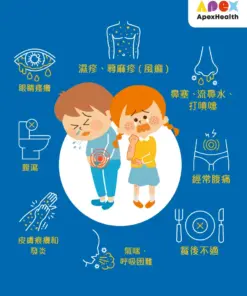
⚠️ Skin Issues

Eczema, itching, skin redness and swelling, and hives? Research shows that early systematic treatment of immune dysregulation can effectively halt the Atopic March — the clinical progression from infant eczema to childhood asthma and adolescent allergic rhinitis.

Common Symptoms:Eczema, hives, dry and scaling skin or Atopic dermatitis (AD)

ApexHealth IgE -鼻塞、流鼻水、打噴嚏、哮喘

⚠️ Respiratory Issues

Constantly runny nose and sneezing — and you think it’s just a cold? It could be Allergic Rhinitis. Approximately 40% of school-age children in Hong Kong suffer from allergic conditions, and the majority of allergic rhinitis patients are sensitised to dust mites.

Common Symptoms: Persistent nasal congestion and runny nose, coughing, itchy, watery, or red eyes, even asthma and breathlessness.

ApexHealth IgE -經常腹痛、嘔吐、腹瀉、餐後不適

⚠️ Digestive Issues & Fatigue

Always bloated after meals? Chronically tired without explanation? Research suggests that elevated food-specific IgG antibodies are significantly associated with increased intestinal permeability (“Leaky Gut Syndrome”), particularly with wheat, eggs, and dairy.

Common SymptomsUnexplained skin problems (acne, eczema), bloating, diarrhea, or constipation after meals, Irritable Bowel Syndrome (IBS), chronic fatigue, difficulty concentrating, etc.

Identifying Your Allergens Is the First Step to Reducing Risk

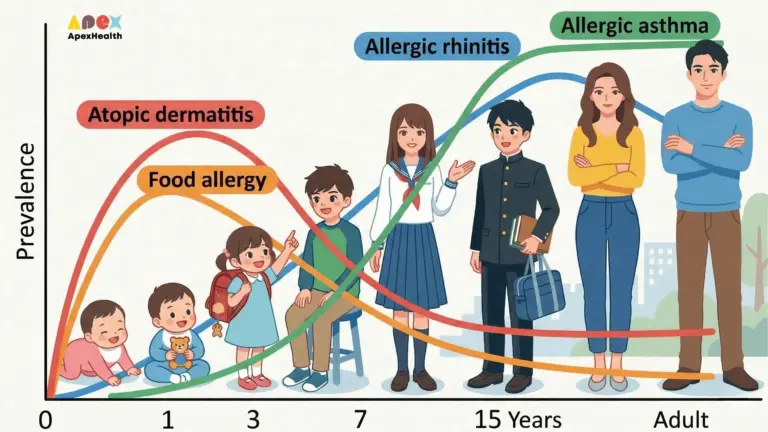
Atopic March

ApexHealth - 過敏進行曲 (Atopic March)

Atopic March

Allergic diseases may follow a characteristic pattern of progression known medically as the “Atopic March.” This refers to a subgroup of children who develop atopic dermatitis (eczema) early in life, and may later go on to develop food allergy, allergic rhinitis, or asthma.

Studies suggest that early-onset, persistent, or more severe atopic dermatitis, especially when associated with IgE sensitization, is linked to a higher risk of developing asthma or allergic rhinitis later on. Early IgE testing and timely intervention may help identify risk factors and support earlier management.

Why Early Intervention Matters

Early clinical assessment, together with IgE testing, skin care, inflammation and environmental management, may help improve symptoms and support the identification of future allergy-related risks.

Common Allergy Types

Allergic reactions can broadly be divided into two categories: food allergy and inhalant allergy.

Every individual’s triggers and symptoms are different. Severity ranges from mild nasal symptoms to anaphylaxis — a serious, life-threatening acute allergic reaction.

Inhalant Allergens

Inhalant allergens are the primary cause of year-round persistent symptoms. The home environment is typically viewed as a safe “sanctuary,” yet it actually conceals numerous allergens — from mold spores that may grow in bathroom corners to dust mites invisible to the naked eye within pillowcases, lurking everywhere. The most common indoor allergens include animal dander, dust mites, mold, and cockroaches.

ApexHealth IgE - Inhalant Allergens
ApexHealth IgE - Food Allergens

Food Allergens

In IgE-mediated food allergy, IgE antibodies within the immune system mistakenly identify normally harmless foods (such as eggs) as threats, triggering an allergic response. The most common food allergens — those responsible for the majority of reactions — include milk, eggs, peanuts, tree nuts, shellfish, fish, wheat, soy, and sesame.

CommonAllergy Test MethodComparison

皮膚點刺檢測 SPT APexHealth
Skin Prick Test(SPT)
Blood test
Allergen-specific IgE antibody test
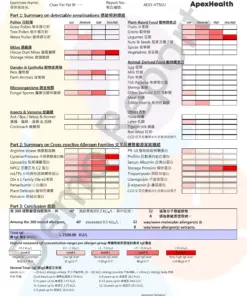
精準定位致敏元兇 - Alex3 敏感測試 - ApexHealth
Molecular Allergy Component Testing
How it works
Allergen extract is placed on the skin; the surface is pricked and observed for an immediate reaction such as redness and swelling within 15 minutes
A blood draw measures the concentration of IgE antibodies targeting specific allergens in serum
Nano-microarray chip technology measures IgE levels against hundreds of molecular allergens in a single blood draw, with a built-in CCD Blocker to eliminate false positives
Coverage
Approx. few to dozens of whole allergen extracts per session
Approx. 100–150 whole allergens
hundreds of molecular allergens covering both inhalant and food components
Advantages
✅ Immediate results (15 min), intuitive
✅ Lower cost
✅ Simple and quick testing procedure
✅ No need to stop medication
✅ No risk of triggering a reaction
✅ Suitable for those with poor skin condition (eczema, psoriasis)
✅ Molecular-level risk assessment: distinguishes high/low-risk proteins
✅ No need to stop medication (anti-histamines)
✅ Won’t trigger allergic reaction
✅ Identifies cross-reactive allergens (e.g. dust mite ↔ shellfish)
Limitations
❌ Difficult for patients with eczema or psoriasis
❌ Must stop antihistamines 7 days prior
❌ May trigger an allergic reaction
❌ No molecular-level analysis
❌ Cannot assess severity of reaction
❌ Cannot identify cross-reactivity
❌ Higher cost
❌ Detailed report requires interpretation by a qualified medical professional
Best for
Suitable for all ages
Complimentary with SPT; patients who cannot stop medication
Complex or multiple allergy cases; precision risk assessment; identifying cross-reactive patterns

Why Choose ApexHealth Allergy Specialists?

As one of Hong Kong’s leading health technology organizations, ApexHealth is committed to providing internationally accredited allergy testing services:

  • Broad coverage: Tests for hundreds of environmental and food allergens.
  • Professional team: Managed by professional medical lab technologist and registered healthcare professionals, ensuring the testing process meets the highest medical standards.
  • Extensive experience: With many years of clinical experience, we have handled over 1,000 allergy testing cases and are highly trusted by patients.
  • Professional interpretation: Provides comprehensive testing with a detailed medical report, along with explanation by doctor or healthcare professionals and tailored improvement recommendations.
ApexHealth Testing Center Front

Four Core Advantages

Reliable

High accuracy, allowing precise reflection of a patient’s degree of sensitivity to each allergen, and effectively distinguishing cross-reactive allergens, helping the medical team develop a personalized allergy management plan.

Convenient

Suitable for people of all ages, including infants and young children, older adults, and patients with severe eczema or psoriasis.

Comprehensive

Using advanced allergy testing technology, a single blood sample can test around 300 molecular-specific allergens, covering pollen, food, animal dander, mould, and more, allowing for a comprehensive identification of the root cause of allergies.

Safe & Fast

Unlike traditional skin prick testing, blood testing will not trigger an allergic reaction, making it very safe. A finger-prick blood sample can also be used, greatly reducing the psychological burden on infants and children.

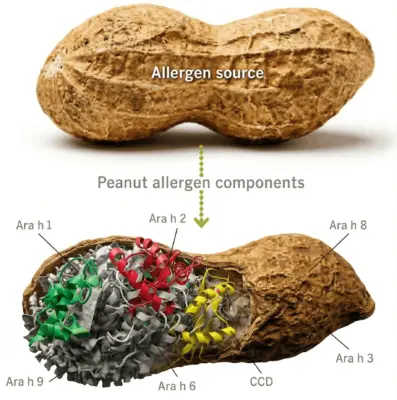
peanut-allergen-component

Molecular vs. Whole Allergen Extract Testing: What's the Difference?

Traditional tests extract the entire allergen source (e.g. a whole peanut, an entire dust mite) — they can tell you “you’re allergic to peanuts,” but cannot tell you which specific protein is responsible or how severe the risk is.

Cross-Reactivity

Real Patient Story: A patient eliminated seafood, eggs, and dairy for two years due to recurring hives, experiencing significant weight loss and reduced quality of life.

After ApexHealth molecular testing, results revealed she was only severely allergic to dust mites (Der p 1,2) — the food reactions were all cross-reactivity, not true food allergy. After modifying her home environment, her symptoms improved dramatically and her diet returned to normal.


Testimonials

Ms. Lee

“For years, allergies plagued me, severely impacting my quality of life… Finally, IgE and IgG tests revealed dust mites and nuts were the culprits! After adjusting my environment and diet, my symptoms improved significantly, giving me a new lease on life!”

August 20, 2018

Mr. Chan

“As an athlete, I suffered from joint pain and swelling, hindering my training… An IgG test showed certain food allergies were causing inflammation. Once I avoided those foods, my joint issues subsided, allowing me to train at full capacity again!”

May 5, 2020

Ms. Wong

“My 2-year-old had severe eczema, and many doctors couldn’t find a cure… Through IgE and IgG testing, we discovered he had severe reactions to many foods and environmental allergens. Avoiding those triggers steadily improved his skin condition!”

April 10, 2021

Other Allergy Testing or Food Sensitivity Test

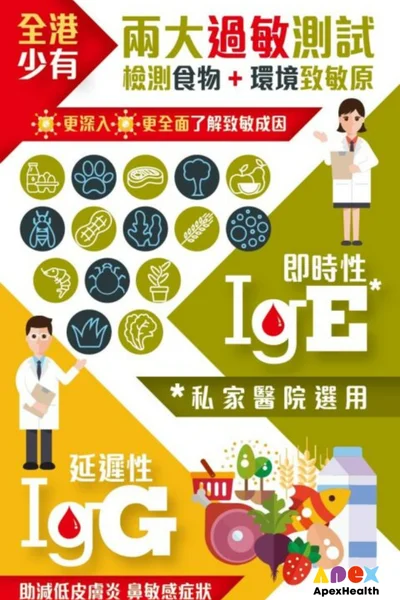
IgG Delayed Sensitivity Allergy Test

IgG Delayed Food Sensitivity Test

Suitable for individuals with chronic inflammation and long-term allergic conditions such as eczema and gastrointestinal issues
$ 4,000
  • Covers up to 220+ food allergens
  • Including common dairy products, seafood, fruits, grains, herbs, meats, nuts, vegetables, and other foods
  • ISO 13485 accredited
  • Suitable for children aged 2 and above, and adults
  • Professional healthcare report interpretation
Alex 3 long

IgE ALEX3 Immediate Allergy Test

Suitable for individuals with asthma, urticaria (hives), eczema, rhinitis, and acute diarrhea
$ 4,980
  • 295 food and environmental molecular allergens
  • Suitable for individuals with asthma, urticaria (hives), eczema, rhinitis, and acute diarrhea
  • CE-IVD accredited
  • High accuracy, precisely reflecting the patient's allergen sensitivity
  • Precise molecular detection to identify cross-reactive allergens.
  • Professional healthcare report interpretation
Combined IgG and IgE Allergy Test

Combined IgG + IgE Allergen Test

Suitable for individuals with various types of allergic symptoms
$8980
$ 8,082
  • Comprehensive IgG Food + IgE Environmental Allergen Coverage
  • Helps reduce chronic inflammation and prevent acute allergic reactions
  • A dual approach to effectively improve allergic constitution
  • Suitable for children aged 2 and above, and adults
  • Professional healthcare report interpretation
Comprehensive

Gut Microbiome PCR Test

Why is gut health so closely linked to allergy?

Approximately 80% of the body’s immune cells reside in the gut. Gut dysbiosis is one of the underlying drivers of allergy:

Gut dysbiosis → Increased intestinal permeability (“Leaky Gut”) → Food proteins enter the bloodstream → Chronic inflammation and allergic sensitisation.

Research shows that allergic children have significantly lower gut microbiome diversity compared to healthy children.

ApexHealth uses advanced real-time quantitative PCR (qPCR) technology to precisely quantify specific gut bacterial strains — identifying exactly which probiotics your microbiome is lacking, so you can supplement with a targeted, evidence-based protocol.

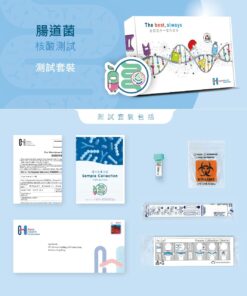
如何改善腸道微生態 | 腸道菌檢測

Deep Comparison: IgE Immediate Allergy vs IgG Delayed Food Sensitivity

Comparison
IgE Immediate Allergic Sensitisation Test (Type I)
IgG Delayed Food Sensitivity / Food Intolerance Test (Type III)
Response Time
Symptoms usually occur within minutes to two hours after exposure to the allergen.
Symptoms may appear several hours to several days after eating the trigger food.
Common Symptoms
Symptoms may include sneezing, runny nose, acute urticaria (hives), difficulty breathing, and even shock.
Symptoms may include chronic eczema, long-term fatigue, migraines, gastrointestinal discomfort (such as diarrhea and bloating), and joint pain.
Allergens Sources
Pollen, dust mites, animal hair, peanuts, seafood, etc.
Daily foods such as dairy products, gluten, eggs, etc.
Detection Difficulty
Symptoms are obvious and easier to notice, but testing is still needed to confirm the specific allergen molecules.
Symptoms are hidden and delayed, making them extremely difficult to identify on your own, so blood testing is necessary for screening.
Suitable for
People with asthma, acute urticaria, rhinitis, and acute diarrhea.
People who have long-term chronic inflammation, eczema, and gastrointestinal problems but cannot find the cause.

Common FAQs

Yes, our allergy test uses a small amount of blood sample. Compared to traditional skin prick testing, blood testing is safer and will not trigger a severe allergic reaction. For infants and young children who are anxious about blood draws, we offer a finger-prick micro-sampling option, which is quick and causes minimal discomfort.

We recommend fasting for 2 hours before your blood draw.

Regarding medications:

  • ✅ Antihistamines: do not affect blood test results — no need to stop
  • ✅ Topical corticosteroid creams: do not affect the test
  • ⚠️ High-dose oral corticosteroids or immunosuppressants: may temporarily suppress IgE levels — please consult our team or your doctor before testing.

After the test is completed, your detailed report is generally available within 7 working days. Our professional healthcare team or registered doctor will arrange the report consultation to help you fully understand your allergens and receive personalised advice.

Not necessarily. For IgE immediate allergies, strict avoidance of the allergen is generally recommended. However, for IgG delayed food sensitivities, patients may — under the guidance of a healthcare professional — eliminate the food for a period of time (typically 3 to 6 months), and once antibody levels have decreased and the gut has recovered, there may be an opportunity to gradually reintroduce that food.

ApexHealth’s IgE and IgG blood allergy tests are suitable for children aged 2 and above, as well as adults. Early testing for young children who show signs of eczema or allergic rhinitis can help prevent allergic symptoms from worsening.

Three-Step Appointment Process

Step 1: Order online or enquire by phone — select your test and confirm your appointment time.

Step 2: Visit our centre for a blood draw (approximately 30 minutes) — 2-hour fasting required; antihistamine medication does not affect the test.

Step 3: Receive your report within 7 working days, with a detailed report interpretation by a doctor or healthcare professional, along with personalised dietary recommendations.

The test itself is not a treatment, but through precise testing you can: precisely avoid only the foods that are truly causing your reactions; assess whether allergy immunotherapy is suitable for you; monitor changes over time, as children’s allergy profiles may shift with age and regular re-testing allows progress to be tracked; and combine results with probiotic testing and gut restoration programmes to address the root cause of your allergic constitution.

Looking for precise approach to managing your allergies?

Call us 852-3504 2738 Ask our Expertise